How the Escrow Process Works in California: A Step-by-Step Guide for First-Time Buyers
California's escrow process has strict legal requirements that catch many first-time buyers off guard. This guide walks you through every stage, from opening escrow to getting your keys.
California escrow is a legally required process in which a neutral third party holds funds, documents, and instructions until every condition of the sale is met. This escrow process california guide covers every stage from opening to closing so first-time buyers know exactly what to expect. California has some of the most detailed escrow compliance rules in the country, and missing even one step can delay or kill a deal.

What Is Escrow and Why Does California Require It?
Escrow is a legally binding arrangement where a neutral party, called the escrow holder, manages the transfer of property between buyer and seller. California law requires that escrow companies be licensed by the California Department of Financial Protection and Innovation (DFPI) or operate under a licensed attorney or title company. This protects both parties by ensuring no money or title changes hands until every condition in the purchase agreement is satisfied.
In California, escrow is not optional. It is the standard legal mechanism for transferring residential real estate. The escrow holder acts as a neutral stakeholder who follows written instructions from both buyer and seller. They do not give legal advice or advocate for either side.
Most California residential transactions use an independent escrow company or a title company that provides escrow services. Banks and savings institutions can also hold escrow under California Financial Code Section 17000. The choice of escrow company is typically negotiable between buyer and seller, though local custom often guides the decision.
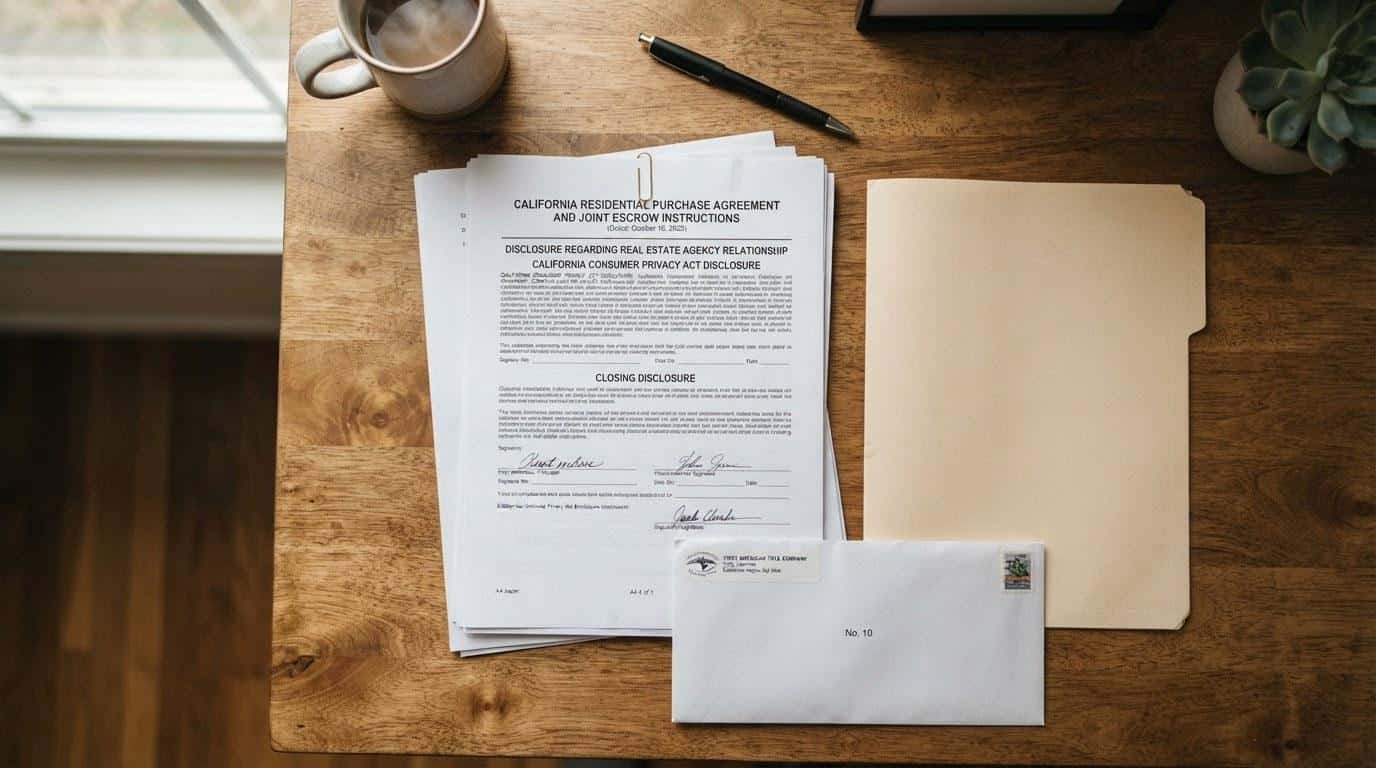
What Are the Key Steps in the California Escrow Process?
California escrow follows a defined sequence that typically spans 30 to 45 days for a standard residential purchase. Each step has a compliance component tied to California law or the terms of the purchase contract. Here is how the process unfolds from start to finish.
- Opening escrow: After the buyer and seller sign the purchase agreement, the listing agent or buyer’s agent delivers it to the escrow company. Escrow is officially opened, and the buyer deposits earnest money, typically 1% to 3% of the purchase price, within 3 business days.
- Title search: The title company searches public records going back at least 40 to 60 years to confirm the seller has clear ownership and to identify any liens, easements, or encumbrances. This usually takes 5 to 10 business days.
- Seller disclosures: California law requires sellers to complete the Transfer Disclosure Statement (TDS), the Natural Hazard Disclosure (NHD), and several other state-mandated forms within the timeframes set in the contract, often within 7 days of opening escrow.
- Home inspection: The buyer has a contractual inspection period, typically 10 to 17 days in California. During this time, the buyer orders a general home inspection and any specialized inspections (roof, pest, sewer, pool).
- Loan processing: The buyer’s lender orders an appraisal, reviews the title report, and processes the loan. The lender issues a Loan Estimate within 3 business days of the loan application under federal RESPA rules.
- Contingency removal: Once the buyer is satisfied with inspections and the loan is approved, the buyer removes contingencies in writing. In California, the standard CAR (California Association of Realtors) contract gives the buyer an active role in removing each contingency individually.
- Signing loan and escrow documents: The lender sends final loan documents to escrow, typically 1 to 3 days before closing. The buyer signs at the escrow office or with a mobile notary. The buyer also wires the down payment and closing costs to the escrow account.
- Recording and funding: The escrow holder sends the signed deed to the county recorder’s office. Once the deed is recorded, the lender releases funds to escrow, and escrow disburses the seller’s proceeds. The buyer receives the keys.
In our experience, the listings that stall in escrow are often the ones where the buyer waited until the last week to schedule inspections, because a delayed inspection report then pushes every subsequent deadline by the same amount of time.
What Compliance Rules Apply During California Escrow?
California has more mandatory seller disclosure requirements than almost any other state. Buyers have specific legal rights during escrow that cannot be waived by contract. Understanding these rules helps you stay on the right side of the law and avoid deals that unravel at the closing table.
Here are the key compliance requirements every California buyer and seller must know:
- Transfer Disclosure Statement (TDS): Required by California Civil Code Section 1102 for nearly all residential sales of 1 to 4 units. The seller must disclose known material defects. Buyers have 3 days after receipt (or 5 days if mailed) to cancel the contract based on the TDS.
- Natural Hazard Disclosure (NHD): Sellers must disclose whether the property is in a flood zone, fire hazard severity zone, earthquake fault zone, or other state-designated hazard area. The California Office of the State Fire Marshal maintains the official fire hazard zone maps used in this disclosure.
- Lead-based paint disclosure: Required by federal law for homes built before 1978. Buyers have 10 days to conduct a lead inspection before waiving this right.
- Mello-Roos and HOA disclosures: If the property is in a Community Facilities District, the seller must disclose the special tax. HOA documents, including CC&Rs and financial statements, must be delivered within the contract timeline.
- Smoke and carbon monoxide detectors: California Health and Safety Code requires sellers to certify that the home has working smoke detectors and carbon monoxide detectors before close of escrow. Water heater strapping is also required.
- FIRPTA compliance: If the seller is a foreign national, the buyer may be required to withhold up to 15% of the purchase price for federal tax purposes under the Foreign Investment in Real Property Tax Act.
- Prop 19 property tax reassessment: As of February 2021, California’s Proposition 19 changed the rules for transferring property tax base values between family members. Buyers should understand how the purchase will affect their property tax bill going forward.
California’s escrow compliance rules are updated periodically. As of 2024, new legislation under California Civil Code continues to expand disclosure requirements, particularly around wildfire risk and insurance availability. Buyers should confirm which disclosures apply to their specific property and county.
How Much Does Escrow Cost in California?
Escrow fees in California typically range from $1,500 to $3,500 for a median-priced home, though the total depends on the purchase price, the escrow company, and the county where the property is located. Costs are usually split between buyer and seller, though this is negotiable and varies by region.
Escrow fees in California typically range from $1,500 to $3,500 for a median-priced home, though the total depends on the purchase price, the escrow company, and the county where the property is located.
| Cost Item | Who Typically Pays | Typical Range |
|---|---|---|
| Escrow fee (base) | Split buyer/seller | $1,500 to $3,500 total |
| Title insurance (owner’s policy) | Seller (in most CA counties) | 0.5% to 1% of purchase price |
| Title insurance (lender’s policy) | Buyer | $500 to $1,500 |
| County transfer tax | Seller | $1.10 per $1,000 of value (county rate) |
| Recording fees | Buyer | $15 to $25 per document |
| Notary fees | Buyer | $150 to $300 |
| Home warranty (optional) | Negotiable | $400 to $800 per year |
Several factors move escrow costs higher or lower. A purchase price above $1 million, a complex title history, or a property in a high-demand area like Los Angeles County can all push fees toward the upper end of the range. Some cities also charge an additional city transfer tax on top of the county rate, so buyers should confirm the local rate with their escrow officer early in the process.
Lender fees are separate from escrow fees and are disclosed on the Loan Estimate. Buyers should compare the Loan Estimate to the Closing Disclosure, which the lender must deliver at least 3 business days before signing, to catch any unexpected changes in costs.
For a precise cost estimate on your specific transaction, request a custom quote from Realtor David at (818) 421-2170.

What Are the Most Common Escrow Mistakes First-Time Buyers Make?
Most escrow delays and deal failures trace back to a handful of preventable mistakes. Knowing them in advance puts you in a much stronger position. Here are the errors that show up most often in California residential transactions.
- Making large deposits or purchases during escrow: Any significant change to your bank accounts or credit profile after the lender pulls your initial credit report can trigger a re-underwriting review. Avoid buying furniture, opening new credit cards, or moving large sums between accounts until after recording.
- Missing contingency deadlines: California contracts have firm deadlines for inspections, loan approval, and appraisal. Missing a deadline can mean losing your contingency protection, which means you could forfeit your earnest money if you back out.
- Not reading disclosures carefully: The TDS, NHD, and HOA documents can reveal material issues. Buyers who skim these documents sometimes discover problems after closing that they could have negotiated or walked away from during escrow.
- Wiring funds to the wrong account: Wire fraud targeting real estate transactions has increased sharply since 2020. Always verify wire instructions by calling the escrow company directly using a phone number you looked up independently, not one from an email.
- Assuming escrow protects you from all risk: Escrow ensures the mechanics of the transfer are completed correctly. It does not replace a thorough home inspection, a title review, or a careful read of the seller’s disclosures.
- Skipping a final walkthrough: California purchase contracts give buyers the right to a final walkthrough within 5 days of closing. Use it to confirm the property’s condition matches what was agreed and that all required repairs were completed.
How Does a Buyer’s Agent Help You Through Escrow?
A licensed buyer’s agent manages the compliance timeline, coordinates with the escrow officer and lender, and advocates for your interests at every stage of the process. For first-time buyers navigating California’s detailed disclosure and contingency rules, having professional representation is one of the most practical ways to reduce risk.
Here is what a buyer’s agent does during the escrow period specifically:
- Tracks all contractual deadlines and sends timely reminders so no contingency window is accidentally missed.
- Reviews seller disclosures and flags items that warrant a specialist inspection or a price renegotiation.
- Coordinates the inspection schedule so reports are back within the inspection contingency window.
- Communicates with the lender to monitor loan progress and catch potential delays before they affect the closing date.
- Reviews the preliminary title report for liens, easements, or encumbrances that could affect your ownership rights.
- Attends or coordinates the final walkthrough and documents any issues before you sign closing documents.
- Confirms that all required California compliance items, including smoke detector certification and water heater strapping, are completed by the seller before closing.
As of 2024, California’s new buyer representation agreement rules require buyers to sign a written agreement with their agent before touring homes. This agreement spells out the agent’s compensation and duties, giving buyers a clearer picture of what they are getting from their representation. Realtor David works with buyers across Southern California communities to make sure every escrow compliance requirement is met on time.
This escrow process california guide covers the most common scenarios, but every transaction is different. Properties in gated communities, areas with Mello-Roos assessments, or homes with unpermitted additions all carry additional compliance steps that a knowledgeable agent can help you navigate.
Ready to Close with Confidence?
California’s escrow process has more moving parts than most first-time buyers expect. Missing a deadline, skipping a disclosure review, or misunderstanding a contingency can cost you thousands of dollars or the deal itself.
Realtor David provides full buyer representation and closing procedure management for home buyers across Southern California. From the moment escrow opens to the day you get your keys, every deadline, disclosure, and compliance step is tracked and handled on your behalf.
Call (818) 421-2170 to talk through your situation and get professional guidance before you open escrow on your next home purchase.
Frequently Asked Questions
How long does escrow take in California?
Most California residential escrow periods last 30 to 45 days. Cash purchases can close in as few as 7 to 14 days because there is no loan processing involved. Transactions with complex title issues, unpermitted additions, or lender delays can stretch to 60 days or longer.
Can a buyer back out of escrow in California?
Yes, a buyer can cancel escrow in California during the contingency period without penalty. The most common contingencies are the inspection contingency, the loan contingency, and the appraisal contingency, each of which gives the buyer a specific window to exit. After all contingencies are removed in writing, backing out typically means forfeiting the earnest money deposit.
Who chooses the escrow company in a California home sale?
The choice of escrow company is negotiable between buyer and seller. In Southern California, it is common for the seller to select the escrow company, while in Northern California, the buyer more often makes the choice. Either party can request a specific company, and the purchase contract should specify who is responsible for the escrow fee.
What happens if the seller does not complete required disclosures during escrow?
If the seller fails to deliver required disclosures like the Transfer Disclosure Statement within the contract timeline, the buyer's contingency clock does not start until those documents are received. California Civil Code Section 1102 gives buyers the right to cancel the contract within 3 days of receiving the TDS if they are not satisfied with what it reveals.
Do I need a real estate agent to go through escrow in California?
California law does not require you to use a real estate agent, but buyer representation is strongly recommended for first-time buyers. A licensed agent tracks every compliance deadline, reviews disclosures, coordinates inspections, and communicates with the escrow officer and lender on your behalf. Realtor David provides full buyer representation across Southern California and can be reached at (818) 421-2170.